
Regulatory amendments entering into force on 1 October 2026
Royal Decree 518/2026, of 24 June, amends, among other regulations, the General Traffic Regulations. The changes affecting the manual are detailed below.
| Expanded definitions relating to persons |
| People with reduced mobility who move using personal mobility vehicles at walking pace will be regarded as pedestrians. |
| Vulnerable road users or users at greater risk of vulnerability
A road user who, due to the means of transport they use or the physical characteristics of their age group, faces a higher risk of injury in the event of a traffic accident, or of suffering more severe injuries. This category includes pedestrians (specifically persons with disabilities, minors, older people and those with reduced mobility), cyclists, drivers of personal mobility vehicles, and drivers and passengers of motorcycles and mopeds. |
| Revised and expanded definitions relating to the road |
| Pedestrian zone
A part of the street, raised or otherwise demarcated, reserved primarily for pedestrian movement and presence. This definition includes pavements, squares, boulevards, promenades, platforms and other similar areas. |
| Shared‑surface zone (single‑level carriageway and pavement)
An area specifically designed and adapted to facilitate pedestrian movement. In such zones, pedestrians have right of way at any point along the carriageway. Horizontal and vertical signage is kept to a minimum. |
| Residential priority zone or area
A designated area regulated by the municipal authority in which, in order to maintain sustainable use, measures are introduced to restrict access or circulation for vehicles belonging to non‑resident neighbours, along with other measures that support such sustainable use. |
| Safe school route
A set of roads adapted by the competent authority to encourage children to travel to school on foot, by public transport or using non‑motorised means of mobility. Specific signs, road markings or information panels may be installed, as well as speed limits and restrictions for motor vehicles. |
| Changes to the prohibition on using audio helmets or earphones |
| As a general rule, driving while using any type of audio helmet, earphones or similar devices connected to sound‑receiving or sound‑reproducing equipment, or to any other device that reduces continuous attention to driving, is prohibited. The use of mobile phones and any other communication system while driving is likewise prohibited.
Exceptions to the above:
|
| Changes to certain rules affecting pedestrians |
| Specific circulation rules in urban areas
Pavements are the part of the road reserved for pedestrian movement and presence, and the circulation of any type of vehicle on them is prohibited. In other pedestrian areas, the municipal authority may authorise the coexistence of pedestrians with cyclists and users of personal mobility vehicles, while respecting pedestrian priority. If no passable pedestrian area exists, pedestrians may walk on the verge or, if this does not exist or is not passable, on the carriageway, exercising extreme caution and without obstructing traffic. Vehicle drivers, in turn, must adjust their behaviour—particularly speed and distance—to avoid endangering pedestrians. The municipal authority shall regulate the roads and areas where roller skates, skateboards and personal mobility vehicles may circulate, as well as the conditions under which they may do so. Municipal authorities may establish residential priority zones or areas, which may include regulations on access, circulation or parking restrictions for certain vehicles within the zone, loading and unloading arrangements, systems and requirements for daytime or night‑time urban goods distribution, speed limits, and other measures that promote sustainable use of the area. |
| Circulation on the carriageway or the verge
When no practicable pedestrian area exists, pedestrians must walk on the left‑hand verge in the direction of their travel, if it exists and is passable, or otherwise on the carriageway. In both cases, they must keep as far away as possible from vehicle traffic. Exceptionally, pedestrians may walk on the right‑hand side in the direction of their travel when justified by safety reasons. In all cases, the following must walk on the right‑hand side and obey the instructions of authorised officers and any traffic signs they encounter:
Pedestrians who must walk on the verge or the carriageway shall do so as close as possible to the outer edge, with caution, without obstructing traffic, and walking one behind the other. Where a refuge, pedestrian area or other suitable space exists, no pedestrian may remain standing on the carriageway or the verge, not even while waiting for a vehicle. In such cases, they may only step onto the carriageway to board the vehicle, and only when it is already level with them. |
| Night-time circulation
Pedestrians who walk on the carriageway or the verge of interurban roads between sunset and sunrise, or in meteorological or environmental conditions that significantly reduce visibility, must use at least one light‑emitting or reflective element, in accordance with personal protective equipment regulations, which is visible from a minimum distance of 150 metres to approaching drivers. They may also carry other suitable light‑emitting elements to improve their visibility to other road users. Under the same circumstances, groups of pedestrians must additionally carry, on the side closest to the centre of the carriageway, the lights necessary to indicate their position and dimensions. These lights shall be white or yellow to the front and red to the rear, and may, where appropriate, form a single unit. |
| Pedestrian crossings and crossing carriageways
Pedestrians may not cross squares or roundabouts by walking on the carriageway; they must go around them unless a designated pedestrian crossing is provided. |
| Changes to certain rules affecting mopeds, motorcycles, three‑wheelers, quadricycles and quads |
Drivers and passengers of motorcycles or motorcycles with sidecars, three‑wheeled vehicles, quadricycles, mopeds and special “quad”‑type vehicles must use:
|
| The exemption allowing riders with serious medical conditions to forgo the use of protective helmets is abolished. |
| When the aforementioned vehicles are equipped with self‑protection structures and fitted with seat belts (as stated on the corresponding technical inspection card or certificate of characteristics), their drivers and passengers are exempt from using protective helmets, protective gloves and closed footwear, and are instead required to use the seat belt on all types of roads.
In addition, drivers who carry out their professional activity using any of these vehicles must wear a high‑visibility reflective vest, in accordance with personal protective equipment requirements, when travelling on any type of road. |
| Changes to certain rules affecting bicycles and personal mobility vehicles (PMVs) |
| The rider and, where applicable, passengers of bicycles and cycles in general must use an approved or certified protective helmet, properly fastened, on interurban roads. Helmet use is also compulsory on all types of roads for children under sixteen, and on urban roads and through‑routes for riders who use these vehicles in the course of their professional activity. |
| All exemptions from helmet use for cyclists are abolished. |
| PMV riders are required to use an approved or certified protective helmet, properly fastened. Persons under fifteen years of age may not ride PMVs.
When travelling between sunset and sunrise, or in meteorological or environmental conditions that significantly reduce visibility, the following must use at least one light‑emitting or reflective element, in accordance with personal protective equipment regulations, visible from a minimum distance of 150 metres:
In addition, under these circumstances bicycles must have their position lights switched on on any type of road. PMVs must always have their lighting switched on. Riders who use any of the above vehicles in the course of their professional activity must wear a high‑visibility reflective vest, in accordance with personal protective equipment requirements, when travelling on any type of road. The use of personal mobility vehicles is prohibited:
|
| Basic circulation rules for bicycles and PMVs in urban areas
In the absence of a specific lane or designated route, bicycles shall circulate on the carriageway. If a cycle lane or specific route exists, its use is preferred, although it may be made compulsory through sign R‑407a. Cyclists may not ride on pavements (except children under twelve accompanied by an adult walking on foot, when authorised by the municipal authority), but they may circulate in other pedestrian areas, subject to any limitations or restrictions established by the municipal authority, and always respecting pedestrian priority and safety in such areas. Bicycles and PMVs shall preferably circulate in the centre of the lane, insofar as their safety and that of other users allows. On roads with at least two lanes in each direction, they shall use the right‑hand lane. They may use other lanes when changing direction or when required for safety reasons. Drivers of motor vehicles must maintain a minimum separation of five metres from bicycles and PMVs travelling ahead of them in the same lane, and when overtaking must take special care not to endanger them. Bicycles and PMVs may overtake other vehicles on either the right or the left, depending on what is safest. At signal‑controlled junctions and in traffic queues, they may pass vehicles that are stopped or subject to frequent stops, in order to make correct use of advanced stop line markings. On urban roads with a single lane and a speed limit of 30 km/h or lower, and subject to appropriate signage, the municipal authority may permit bicycles and PMVs to circulate in both directions. When vehicles encounter this situation, they must move to the right to allow safe passage; if this is not possible, priority shall be given to vehicles travelling in the established direction of the road. |
| Changes to certain exemptions from the use of seat belts |
| Drivers and passengers of vehicles engaged in emergency services are also exempt from using seat belts or other approved restraint systems, but only when travelling within built‑up areas, and never when travelling on motorways, dual carriageways or conventional roads.
However, passengers in assistance ambulances, equipped to provide technical and medical care en route, are exempt from using seat belts on all types of roads when, during an emergency service, they occupy the patient compartment in order to provide medical assistance while the vehicle is moving. Furthermore, when taxis operate in urban traffic or urban areas of large cities, they may transport persons under 135 centimetres in height without using an approved restraint device adapted to their size and weight, provided that they occupy a rear seat. |
| Exemptions from seat belt use for taxi drivers, goods distributors, and driving school instructors are abolished. |
| Changes to certain rules affecting high‑occupancy vehicle (HOV) lanes |
Use of the lane designated for HOVs is limited to:
As a general rule, all other vehicles and vehicle combinations are prohibited from using HOV lanes, including passenger cars with trailers, as well as pedestrians, cycles, mopeds, personal mobility vehicles, animal‑drawn vehicles and animals. |
| Changes relating to circulation on motorways and dual carriageways |
| As a general rule, pedestrians may not walk on motorways or dual carriageways.
However, occupants or workers of emergency service vehicles, road maintenance and conservation vehicles, roadside assistance vehicles and special vehicles may walk on motorways and dual carriageways when it is strictly essential for the provision of the corresponding service, and provided they take appropriate measures to avoid compromising their own safety or that of other road users. Pedestrians may not request passage (hitchhiking) on any section of motorways or dual carriageways, including toll‑station forecourts. |
| Emergency corridors
On motorways and dual carriageways, when traffic is slowed to walking pace or vehicles come to a stop due to congestion, drivers must move aside to leave a clear space for the passage of approaching priority vehicles. This clear space is known as the emergency corridor. On motorways and dual carriageways with two lanes in the same direction, the emergency corridor must be formed in the centre of the road, between the two lanes. On motorways and dual carriageways with three or more lanes in the same direction, the emergency corridor must be formed between the leftmost lane and the lane immediately to its right. Vehicles in the leftmost lane must move as far left as possible, and vehicles in the remaining lanes must move as far right as possible. On motorways and dual carriageways, when traffic is hindered by snowy road conditions, overtaking is prohibited and vehicles must travel in the rightmost lane, using the adjacent lane only on sections with three or more lanes per direction, leaving the remaining lanes on the left free of obstacles for emergency vehicles and snowploughs. |
| Changes relating to circulation on the verge |
| On long downhill stretches with bends, when safety permits, and except on dual carriageways where cyclists must in all cases use the verge, bicycle riders may leave the verge and use the necessary part of the right‑hand side of the carriageway.
Vehicles required to circulate on the verge are prohibited from travelling in parallel. However, bicycles may travel two abreast on the verge. If the verge does not exist or is not passable or sufficient, they may travel two abreast on the essential part of the carriageway, although they must ride in single file on sections with poor visibility, when they affect traffic flow, or when travelling between sunset and sunrise or in meteorological or environmental conditions that significantly reduce visibility. |
| The authorisation allowing mopeds to travel two abreast is abolished. |
| On certain road sections, duly marked with fixed vertical signage and road markings, extraordinary use of the right‑hand verge by motorcycles may be permitted.
This type of use is only allowed when traffic in the main lanes is completely stopped due to congestion. Speed is limited to 30 km/h, and motorcycles may only travel in single file, exercising extreme caution. Motorcycle riders must ensure they do not endanger drivers of vehicles required to circulate on the verge, and must leave the verge if necessary. Police vehicles, fire‑fighting vehicles, civil protection and rescue vehicles, emergency medical service vehicles, as well as maintenance teams for road installations and infrastructure and roadside assistance vehicles, may use the verge to access an emergency service or when necessary for infrastructure maintenance, provided that:
|
| Changes to certain speed limits |
| If a bus is carrying standing passengers because such operation is authorised, or if the bus is not equipped with seat belts, the maximum speed—regardless of the type of road outside built‑up areas—shall be 80 kilometres per hour. |
| The requirement for cycles towing a trailer or semi‑trailer to reduce their speed by 10% relative to their general speed limits is abolished. |
| Changes to certain rules relating to passing stationary vehicles |
| When a vehicle is immobilised on the road due to breakdown or accident, or because an emergency service, roadside assistance, road maintenance, or traffic regulation, control or management activity is being carried out, and it occupies all or part of the carriageway in the lane of travel, vehicles passing it must maintain a minimum lateral clearance of 1.5 metres, even if this requires occupying the part of the carriageway reserved for the opposite direction.
They must also reduce their speed by at least 20 km/h below the posted limit on that road. |
| Changes to certain rules relating to the execution of the overtaking manoeuvre |
| The driver who overtakes pedestrians, animals, animal‑drawn vehicles, mopeds, personal mobility vehicles, cyclists or groups of cyclists must exercise particular care during the manoeuvre to avoid creating any situation of danger for them. In addition, the overtaking manoeuvre must be carried out by occupying part or all of the adjacent or opposite lane of the carriageway, as appropriate, and maintaining a minimum lateral clearance of 1.5 metres, except where the carriageway has more than one lane in each direction, in which case a complete lane change is mandatory.
Furthermore, if any of the above overtaking manoeuvres take place outside built‑up areas, the overtaking driver must reduce their speed by at least 20 km/h below the posted limit on the road, both before initiating the manoeuvre and throughout its execution, in order to ensure that the stability and safety of the overtaken users are not compromised. |
| The obligation to maintain a lateral clearance of at least 1.5 metres when overtaking two‑wheeled motorcycles outside built‑up areas is abolished |
| When cyclists ride in a group, they shall be considered as a single mobile unit.
Additionally, the rider of a two‑wheeled vehicle who intends to overtake another vehicle outside built‑up areas must do so in such a way that a space of no less than 1.5 metres is maintained between them and the overtaken vehicle. |
| Changes to certain overtaking prohibitions |
| Overtaking is prohibited when it endangers or obstructs those travelling in the opposite direction, even if they are travelling on the verge.
Overtaking is prohibited at marked pedestrian crossings, at junctions with cycle lanes, and at level crossings, as well as in their vicinity. |
| The possibility of overtaking two‑wheeled vehicles at level crossings, and of overtaking at marked pedestrian crossings when performed at reduced speed, is abolished. |
On road sections where overtaking is prohibited, and after verifying that the manoeuvre can be carried out safely, it is permitted to overtake:
when, due to the speed at which they are travelling, they can be overtaken without risk to them or to general traffic, even if this requires occupying the part of the carriageway reserved for the opposite direction. |
| Changes to the obligation to use high‑visibility reflective vests |
Drivers of the following vehicles must wear a high‑visibility reflective vest, in accordance with personal protective equipment requirements and included among the mandatory equipment of the vehicle, when they exit the vehicle (they must put it on before stepping out) and occupy the carriageway or the verge of interurban roads:
|
| Regulation of motorhome and similar vehicle parking |
Parking motorhomes and other vehicles adapted as dwellings must be carried out under the following conditions:
|
| Change in a cyclist right‑of‑way scenario |
| Cyclists have right of way when a motor vehicle or moped, in permitted circumstances, turns right or left to enter another road and a cyclist is nearby. |
| Changes to certain pedestrian right‑of‑way scenarios |
Regardless of other situations, pedestrians have right of way over vehicles in the following cases:
|
| Changes to the behaviour required from other road users when a priority vehicle approaches |
| As soon as they perceive the special signals announcing the approach of a priority vehicle, other drivers must take appropriate measures, according to the circumstances of the moment and place, to facilitate its passage—normally by moving to their right or stopping if necessary, or, on motorways and dual carriageways, acting in accordance with the rules on emergency corridors.
Pedestrians, upon noticing the visual or acoustic signals of priority vehicles, must clear the carriageway and remain in refuges or pedestrian areas, if available, or otherwise move away from the vehicle circulation zone. |
| Changes to rules on transporting people and loads on cycles |
| Bicycles and other cycles may transport loads and passengers if the rider is an adult and the regulatory technical requirements are met.
Bicycles and other cycles which, by design, cannot carry more than one person may transport children up to 22 kg who are able to sit unaided, provided they use additional seats that meet the established technical specifications. In all cases, the transport of people or loads must be carried out in such a way that they cannot drag, fall wholly or partially, move dangerously, compromise the stability of the vehicle, or obscure lighting or optical signalling devices. Trailers, semi‑trailers or other elements meeting the established technical specifications may be used to transport people, animals up to 15 kg, or loads:
|
| Changes to rules on transporting minors on mopeds and motorcycles |
| The protective helmet worn by the minor must be approved. |
| Changes relating to spare parts, tools and accessories |
| Motorcycles must carry a high‑visibility reflective vest that meets personal protective equipment requirements. |
Amendment to the General Vehicle Regulations
Order PJC/528/2026 of 26 May amends several annexes of the General Vehicle Regulations. The most significant changes are outlined below:
Minimum tyre tread depth
Tyres must, throughout their use on public roads, maintain a depth in the main grooves of the tread pattern that is at least:
- 1.6 millimetres for vehicles in categories M1, N1, O1 and O2.
- 1.0 millimetres for vehicles in categories M2, M3, N2, N3, O3 and O4.
The main grooves are the longitudinal and transverse grooves that form part of the primary tread pattern.
Special tyres
Special tyres are understood to be those snow tyres with specific approval requirements for use in severe snow conditions, identified on the sidewall with the marking M+S, M&S or M.S, together with the 3PMSF pictogram (Three Peak Mountain Snow Flake).
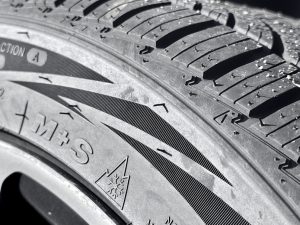
Special tyres are also understood to include those designed and approved for professional off‑road use, identified on the sidewall with the marking M+S, M&S or M.S, together with the initials POR (Professional Off‑Road).

Special tyres must have a speed capability equal to or higher than the vehicle’s maximum intended speed, or at least 160 km/h if the vehicle’s maximum speed exceeds this value. If the tyre’s speed rating is lower than that indicated on the vehicle’s technical data sheet, the driver must be reminded of the speed limit in a visible place inside the vehicle.
For compliance with winter mobility restrictions:
- Vehicles with a Maximum Authorised Mass ≤ 3,500 kg must be fitted with 3PMSF‑certified tyres on all axles.
- Vehicles with a Maximum Authorised Mass > 3,500 kg must be fitted with 3PMSF or POR‑certified tyres at least on the steering axle and the drive axles.
Outside winter mobility restriction zones and periods, vehicles may be fitted with different types of tyres on different axles.